
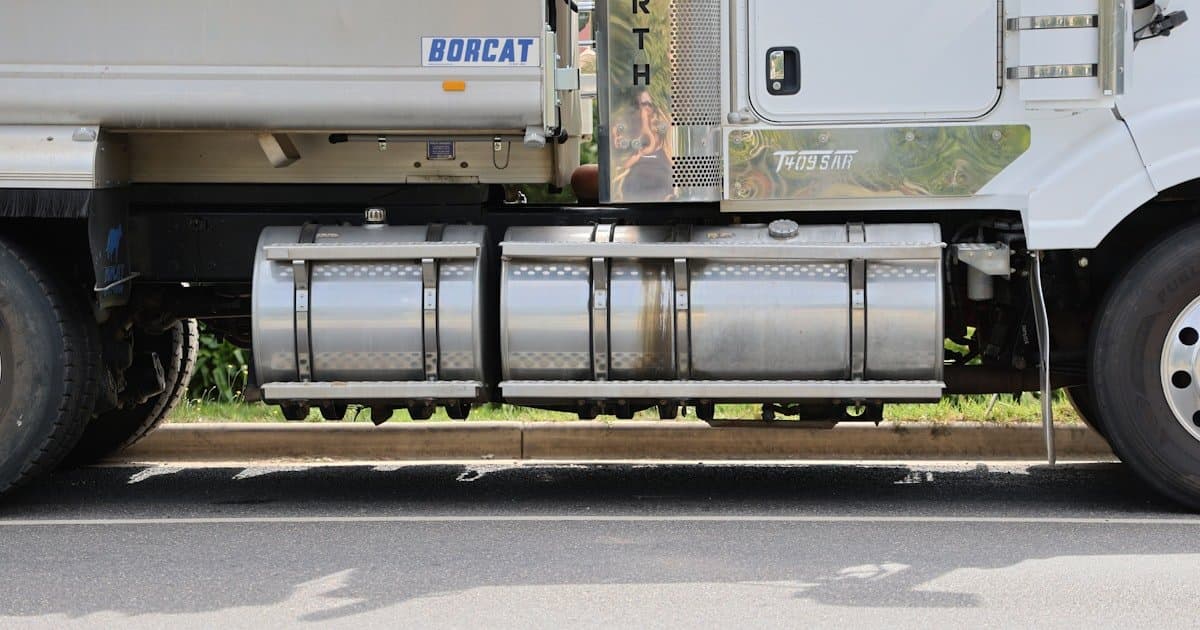
Trucking GPS fuel management means putting two records side by side: what the fuel bill says you bought, and what the tracking data says the truck actually did. Neither one is much use alone. A fuel statement tells you litres and money but not where they went. A live map tells you where the truck went but not what it cost. Together they show the gap, and in most trucking operations that gap is larger than anyone expects.
Fuel is usually the biggest cost a haulage business can influence, and it is also the easiest place to lose money quietly, because a truck spends its life somewhere nobody from the office can see.
Why trucking is different
A delivery van comes back to the yard every evening. A truck might be gone for three days, refuel twice at stations you did not choose, idle for hours at a loading bay, and take a route nobody reviewed. Every one of those is a fuel decision made without supervision, which is not a criticism of drivers. It is simply how long-distance work operates.
That is why generic fleet fuel advice underperforms in trucking. Coaching a van driver on gentle acceleration is worth something. On a truck doing long motorway runs, the bigger numbers sit in idling, route choice, speed held over hours, and losses at the pump.
The four places the litres go
1. Idling
Trucks idle for reasons vans do not: waiting to load, waiting to unload, keeping the cab warm or cool during a rest. Some of it is unavoidable and some is habit, and the only way to tell them apart is to look at where and when it happens. Idling at a customer’s gate for two hours every Tuesday is a scheduling problem, not a driver problem. The general approach is in reducing vehicle idling.
2. Speed held over long distances
Fuel consumption rises sharply at higher speeds, and on a four hundred kilometre run that difference compounds. This is one of the few places where a small, permanent change in driving produces a visible monthly number. It also reduces accident risk at the same time, which is rare for a cost measure.
3. Routes nobody reviewed
Long-haul routes tend to be inherited. A driver has always gone that way, so everyone assumes it is the shortest. Tracking history shows the actual distance covered per job, and comparing two drivers on the same run often reveals a difference that has been paid for every week for years. Route work is covered in route optimization for delivery fleets, and most of it applies to line haul as well.
4. Fuel that never reached the tank
This is the uncomfortable one, and it is why the two records have to be compared rather than read separately. A fuel card statement shows a purchase. It cannot show whether the fuel went into the assigned truck, another vehicle, or a container. Matching each purchase against the truck’s position and time at that moment is what turns a suspicion into a fact. The detail is in reducing fuel theft in your fleet.
How the two records fit together
The core method is simple enough to run in a spreadsheet before you automate any of it.
| From the fuel record | From the tracking data | What the pair tells you |
|---|---|---|
| Litres purchased | Distance actually driven | Real consumption per truck, not a fleet average |
| Time and place of purchase | Where the truck was at that time | Whether the fuel could have gone into that truck |
| Purchase frequency | Engine hours and idle time | Whether high use is work or waste |
| Cost per fill | Route taken | Whether cheaper stops existed on the same route |
Notice that every row needs both halves. This is the reason fuel projects stall: the finance side has the statements, the operations side has the tracking, and nobody puts the two in one place.
Consumption per truck, not per fleet
A fleet-wide consumption figure hides everything worth knowing. Two trucks doing similar work should return similar numbers, and when one does not, the reason is always specific: a mechanical fault, a driving habit, a route, or a loss. Comparing each truck against its own history is even better, because it removes the argument about whose route is harder.
What you are looking for is drift. A truck that quietly moves from one consumption figure to a worse one over six weeks is telling you something before it becomes a breakdown or a bill. That is the same logic behind maintenance scheduled on real usage rather than on a calendar.
Setting it up without drowning
- Get an honest baseline first. Two or three weeks of tracking data with nothing changed. Without it you cannot prove any saving later, and somebody will ask.
- Start with idle time. It is the easiest to measure, the easiest to explain to a driver, and mostly habit rather than necessity.
- Then match purchases to positions. Even a monthly manual check on a sample of fills changes behaviour, because people learn the check exists.
- Then look at consumption per truck. Rank them, investigate the outliers, and leave the rest alone.
- Review monthly, not daily. Fuel is a slow number. Watching it daily produces noise and nothing else.
The broader measurement discipline sits in fleet management KPIs, and the equipment side of fuel monitoring is covered in fleet fuel monitoring and improving fleet fuel efficiency. If you haul fuel rather than merely burn it, fuel tanker tracking covers that case.
What to expect
Two honest cautions. First, the first month usually produces a worse-looking picture rather than a better one, because you are finally seeing what was always happening. That is progress, even though it does not feel like it. Second, no saving exists until somebody acts on the data. A dashboard that reports idle time to nobody in particular changes nothing at all.
The operations that get results give one named person the monthly review and a short list of things to act on. That is the whole method, and it is duller than the software demos suggest.
Frequently asked questions
What is trucking GPS fuel management?
It is the practice of comparing fuel purchase records against GPS tracking data for the same truck and period, so consumption, idling, route distance and the timing of each fill can be checked against what the vehicle actually did. Either record alone leaves the important questions unanswered.
Can GPS tracking detect fuel theft?
It can detect the circumstances that reveal it. Matching each purchase against the truck’s location and time at that moment shows whether the fuel could have gone into that vehicle, and comparing litres bought against distance driven shows whether the totals make sense. Fuel-level sensors add direct evidence of sudden drops where they are fitted.
How much fuel does idling actually waste in trucking?
It varies with the engine, the load and whether cab heating or cooling is running, so a single figure would be misleading. The useful approach is to measure your own idle hours per truck, compare trucks doing similar work, and focus on the outliers rather than chase a published benchmark.
Do I need fuel sensors, or is GPS enough?
GPS with distance, idle time and engine hours is enough to find most waste and to check purchases against positions. Fuel-level sensors add a direct reading of the tank, which matters most where siphoning is a known problem or where tanks are large enough for a loss to hide.
How long before fuel savings show up?
Idling responds within weeks because it is habit. Route and scheduling changes take a month or two to show clearly. Consumption per truck is a slow number and should be reviewed monthly, not daily, or normal variation will look like a trend.
See where your fuel is going
Distance, idle time, engine hours and route history for every truck, in one place, ready to set against your fuel records. Get a Fleetile demo and see it on the Fleetile platform.