Telematics is the technology that collects data from a vehicle, its location, speed, fuel use and engine health, and sends it wirelessly to software, so a fleet manager can track and manage vehicles from anywhere. It combines three things: a telematics device in the vehicle, a mobile (SIM) connection, and a dashboard. This guide is the starting point for the subject: what the word means, what the parts are, what the data looks like, how it differs from plain GPS tracking, and where to read more on each piece.
If you have ever wondered how a manager can see a vehicle’s exact location, speed and fuel level from a laptop miles away, the answer is telematics. So what is telematics? In short, it is the technology that turns a moving vehicle into a stream of live data you can read, act on and store. This guide explains the pieces involved, the kind of information they capture, and why telematics has become the backbone of every serious fleet operation.
What is telematics, exactly?
The word “telematics” blends telecommunications (sending data over a network) with informatics (processing that data). Put together, telematics is the practice of collecting information from a vehicle and transmitting it wirelessly to a central system where it becomes useful. A small device fitted to the vehicle reads location and status, a mobile data connection carries that reading to the cloud, and software turns thousands of those readings into maps, reports and alerts.
That is the short telematics definition. A longer one is worth having too, because the word is used loosely. To define telematics properly you need three conditions met at once: something in the vehicle is measuring, something is transmitting those measurements off the vehicle while it is still moving, and something at the other end is turning them into information a person can act on. A dashcam that records to a memory card is not telematics. A tracker that reports its position to a server every few seconds is.
You do not need to understand the electronics to benefit from it. For a fleet owner, telematics simply means one thing: you always know what your vehicles are doing, without phoning a driver or guessing from a fuel receipt.
The parts of a telematics system
Every telematics system, from a single car to a fleet of hundreds, is built from the same four parts. Knowing them makes every other decision easier, because most questions about telematics are really questions about one of these four.
- The telematics device. The unit in the vehicle. It holds a GPS receiver for position and, depending on the type, reads the vehicle’s own electronics for engine and fuel information.
- The connection. A data SIM inside the device carries readings over the mobile network. This is what makes the data live rather than something you download later.
- The platform. The software that receives the stream, stores it and presents it as a map, a trip history, a report or an alert.
- The people and the process. The part that is easiest to skip and most often the reason a rollout disappoints. Data changes nothing until somebody is expected to look at it and act.
How telematics works
The chain runs from the vehicle to your screen and back again. A device fitted in the vehicle fixes its position and reads what the vehicle’s systems will tell it. A data SIM sends those readings over the mobile network, usually every few seconds. The platform receives the stream, stores it and turns it into a live map, a trip history, a driver score or an alert. When you send a command back to the vehicle, such as a remote immobilisation, it travels the same path in reverse.
Two details decide how useful the result is. The first is reporting interval: a reading every few seconds produces a route you can actually follow, while a reading every few minutes produces a set of disconnected dots. The second is how deeply the device is wired in, which decides whether you get location alone or location plus fuel, engine hours and fault codes.
For the full journey, step by step, including what happens when a vehicle drives through a tunnel or a dead zone, read how does telematics work.
Telematics in cars and light vehicles
Most people meet telematics in a car before they meet it in a fleet. Car telematics covers the same chain in a smaller package: a unit that knows where the vehicle is and how it is being driven, reporting to an app or a portal. What it is used for is what differs.
In vehicle telematics for a private car is usually about recovery after theft, a record of journeys for expenses, or an insurance product that prices a policy on how the car is actually driven. Auto telematics fitted by a manufacturer, often called onboard telematics or an embedded system, arrives with the vehicle and reports to that manufacturer’s own service. Aftermarket telematics for cars is fitted afterwards and reports to whoever you choose, which is why mixed fleets and older vehicles almost always use it.
The practical difference for a business running cars alongside vans or trucks is coverage. Onboard telematics only covers the makes that shipped with it, and each one reports to a different place. An aftermarket telematics device gives every vehicle in the fleet, whatever its age or badge, one common set of data in one platform.
Telematics and navigation
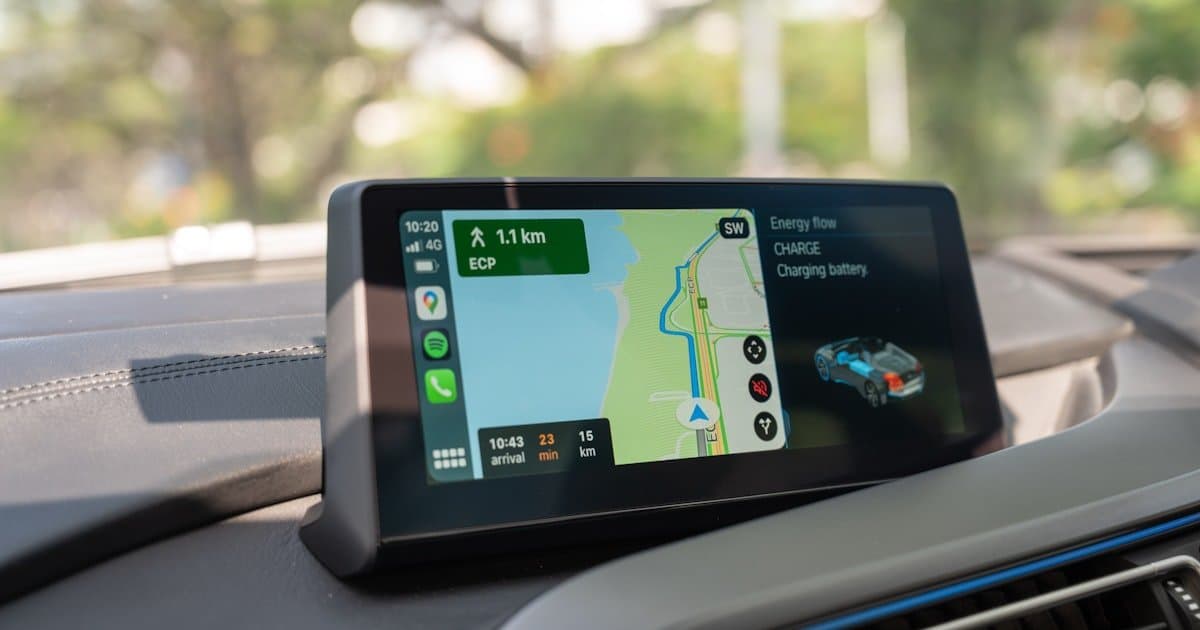
Telematics and navigation get confused because both involve GPS and a map, but they point in opposite directions. Navigation is for the person in the vehicle: it takes your position and tells you where to go next. Telematics is for the people who are not in the vehicle: it takes the same position and reports it to somewhere else.
Telematics navigation, where the two are combined, means the office can send a destination or a route to the driver’s screen and then see whether it was followed. That matters for delivery work, where the question is rarely “where is the next drop” and usually “did the vehicle go where it was supposed to, and what happened on the way”. A navigation unit on its own cannot answer the second question, because it keeps no record anyone else can see.
Telematics vs GPS tracking: what is the difference?
People use the two terms as if they mean the same thing. GPS tracking answers one question: where is the vehicle. Telematics answers that question and then keeps going, adding how the vehicle is being driven, what the engine is reporting, how much fuel is being used and what happened on every trip.
Put simply, GPS tracking is a dot on a map, and telematics is the dot plus the story behind it. Every telematics system includes GPS tracking; not every GPS tracker is a telematics system.
For a fuller comparison, including where the extra cost is and is not worth paying, read telematics vs GPS tracking. If you want the mechanics of positioning itself, how GPS vehicle tracking works covers that.
What data does telematics capture?
Telematics data falls into a few groups, and almost every report or alert you will ever use is built from them:
- Position and movement: location, speed, heading, ignition state, idling, distance and stop duration.
- Driving behaviour: harsh braking, rapid acceleration, sharp cornering and speed violations, usually combined into a score per driver.
- Vehicle condition: engine hours, fuel level or consumption and fault codes, where the device is wired deeply enough to read them.
- Context and events: geofence entries and exits, tamper and power-loss alerts, and anything else you set a rule against.
The set you actually get depends on the device and the install, not on the platform. For what each field means in practice and how to turn it into a decision, read telematics data.
Types of telematics device
A telematics device is not one thing. Plug-in units go into the vehicle’s diagnostic port and can be moved between vehicles in seconds. Hardwired units are fitted to the vehicle’s electrics and are far harder to remove, which is what you want where theft is the concern. Battery units have no power connection at all and are used on trailers, containers and equipment that has no engine to draw from. Embedded units are built in by the manufacturer.
The choice decides what data you get and how easily the unit can be defeated. Telematics devices covers the four types and how to pick one.
Why telematics matters for a fleet
Fleet telematics is where the technology earns its keep, because a fleet has problems that a single vehicle does not: work spread across people you cannot see, costs that hide in small amounts repeated hundreds of times, and disputes that come down to one person’s word against another’s.
Telematics fleet management changes that in a few specific ways. Idling and unauthorised use become visible instead of invisible. Driver coaching moves from general accusation to specific events with a time and a place. Customer disputes are settled with a record rather than a recollection. Maintenance runs on actual engine hours and distance instead of a calendar. And utilisation reporting shows which vehicles are genuinely busy and which only look busy.
None of that happens automatically. A telematics fleet management system produces the evidence; someone still has to use it. For what changes in day to day operations once it is running, read fleet telematics.
Getting started with telematics
Most rollouts fail for the same reason: the hardware goes in and nothing is decided about who looks at the results. A workable order is to pick the two or three questions you want answered first, fit a small group of vehicles rather than the whole fleet, agree who reviews what and how often, tell drivers before the devices arrive rather than after, and only then expand.
Telling drivers first is not a courtesy, it is the difference between a tool and a grievance. For a full rollout plan, read telematics implementation. If you are choosing hardware, remember that a platform which works with devices you already own saves replacing units that are still perfectly good.
A short telematics glossary
- Telematics: collecting data from a vehicle and sending it wirelessly to software that makes it useful.
- Telematics device: the unit in the vehicle that measures and transmits. Also called a tracker or a telematics unit.
- Onboard telematics: a system built into the vehicle by its manufacturer, rather than fitted afterwards.
- Fleet telematics: telematics applied across a group of vehicles, with reporting and management built for the group rather than one vehicle.
- Geofence: a boundary drawn on the map so that crossing it raises an event.
- Reporting interval: how often the device sends a reading. It decides how detailed the route history is.
- Driver score: a single figure per driver built from harsh braking, acceleration, cornering, speeding and idling.
Frequently asked questions
What is telematics in simple terms?
It is a device in a vehicle that measures where the vehicle is and what it is doing, and sends those measurements over the mobile network to software you can open on a phone or a computer. That is the whole idea; everything else is detail about what gets measured and what the software does with it.
What is the meaning of the word telematics?
It is a blend of telecommunications and informatics. The telematics meaning in practice is the combination of the two: sending vehicle information over a network, and processing it into something usable at the other end.
Is telematics the same as GPS tracking?
No. GPS tracking tells you where a vehicle is. Telematics includes that and adds behaviour, engine and fuel data, trip history and alerts. Every telematics system contains GPS tracking, but a basic GPS tracker is not a telematics system.
Do I need special hardware for telematics?
You need a telematics device in the vehicle, but it does not have to be new or a particular brand. Fleetile works with over 200 GPS devices and has no hardware lock-in, so units already fitted to your vehicles can usually keep reporting rather than being replaced.
What kind of data can telematics collect?
Location, speed, distance, trip start and end, idling, ignition state, harsh braking and acceleration, geofence crossings and overspeed events as standard. Where the device is wired deeply enough, it adds engine hours, fuel level or consumption and fault codes. The exact set depends on the device and the install.
What is telematics in cars used for?
In a private car it is usually theft recovery, a journey record for expenses, or an insurance policy priced on how the car is actually driven. In a business that runs cars alongside other vehicles, it is used to bring those cars into the same reporting as the rest of the fleet instead of managing them separately.
Is telematics only for large fleets?
No. The same technology works for a single vehicle or hundreds. Because it is usually priced per vehicle, small operators pay only for what they run and still get the full feature set.
Does telematics work without mobile signal?
The device keeps recording when signal drops and sends the stored readings once it reconnects, so the trip history fills back in. What you lose during the gap is the live view, not the record.
Do I have to tell drivers the vehicles are tracked?
Yes, and in most places you are required to. It is also the single thing that most affects whether a rollout works. Drivers who are told beforehand treat it as part of the job; drivers who find out afterwards treat it as surveillance. Our guide to employee vehicle tracking and privacy covers how to handle it.
See telematics on your own vehicles
The clearest way to understand telematics is to watch it run live. Get a Fleetile demo and see location, driver scoring, geofencing and smart alerts working together on real vehicles.